How to Find the Right Distribution Channel for a Startup
Learn how to find the right distribution channel for your startup: list candidates, run cheap tests, score results, and double down on the one that works.
If you are asking how to find the right distribution channel for a startup, start with one idea: you do not pick a channel by taste. You pick it by testing a few cheap options against a clear score and keeping the one that works. This post gives you a method you can run in two weeks, with a worked example.
Why distribution matters more than the product early on
A good product that nobody sees earns nothing. A decent product in front of the right people teaches you fast. Early on, that learning is worth more than polish.
Investor Alex Rampell makes the same point in "Distribution vs. Innovation" on the a16z site. He says the contest between a startup and an established company comes down to "whether the startup gets distribution before the incumbent gets innovation." His example is TiVo, which depended on cable companies that already held the customer relationship. In his telling, the common ending is that the big company builds its own version of your product.
AI makes this sharper. When anyone can call the same model, building gets cheaper and more people build similar things. The lesson "The Collapse in the Cost of Starting" in the Platform Shifts course covers how each platform shift made something expensive cheap. When building is cheap, getting in front of customers becomes the scarce part.
The Age of AI Entrepreneur course "Distribution and Moats" treats this directly. Its lessons are "Distribution: Getting in Front of Customers," "What Moats Survive When AI Is Cheap," and "Building on Someone Else's Model."
The main startup distribution channels at a glance
The book Traction, by Gabriel Weinberg and Justin Mares, covers nineteen channels and offers a three-step framework called Bullseye for working out which ones suit your business. You do not need nineteen. Most early channels fall into a few groups, and you only need to know the menu.
- Direct outreach: emails, messages and calls to people who fit your customer. Slow, but it teaches you the most.
- Communities: forums, group chats and social spaces where your customers already talk about the problem.
- Content and search: posts, guides and tools that answer questions people type into a search box. Slow to start, cheap to keep.
- Paid ads: fast to switch on, and they cost money from the first click.
- Partnerships: someone else with your customers' attention sends them to you.
- Product-led spread: users invite others, or the output of your product carries your name.
- Marketplaces and platforms: listings inside someone else's store or ecosystem. Remember the risk of building on a platform you do not control.
How to find the right distribution channel for a startup: start with the customer
Do not start with the channel. Start with where your customers already spend time. Ask where they go when they hit the problem you solve.
Take a made-up example. You build a prompt-powered tool that turns messy meeting notes into a clean client update for freelance designers. Ask yourself:
- Where do freelance designers ask for help with client work?
- What do they search for when a client update is due?
- Who already has their attention: newsletter writers, template sellers, tool makers?
Write the answers down. If you cannot answer, you do not know your customer well enough yet. The lesson "Talking to Customers Without Fooling Yourself" in the Finding AI Opportunities course helps here. Five real conversations will tell you more about where customers spend time than a day of guessing.
Score channels with a simple framework
Pick three to five candidate channels from your list. Score each from 1 to 5 on these questions:
- Reach: are your customers actually there, in numbers?
- Speed: how soon can you get a first result?
- Cost: how much money and time does a test take?
- Fit: does the channel suit what you sell and how you sell it?
- Control: can someone else change the rules and cut you off?
Add the scores. For the freelance designer tool, you might get:
- Direct messages to designers you find in public groups: reach 3, speed 5, cost 5, fit 4, control 4. Total 21.
- A search-focused guide on client updates: reach 4, speed 1, cost 3, fit 4, control 3. Total 15.
- Paid ads: reach 4, speed 5, cost 1, fit 2, control 2. Total 14.
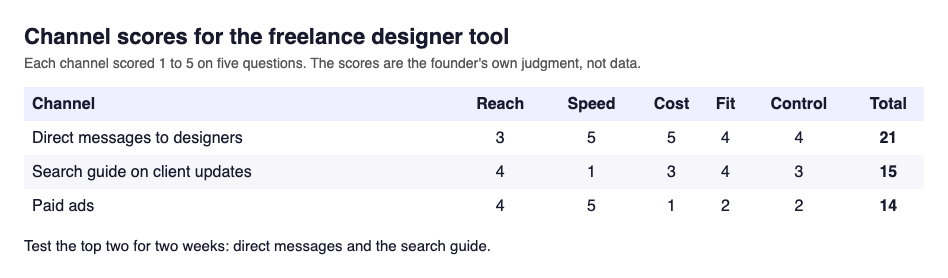
These numbers are your own judgment, not data. That is fine. The point is to force a ranking and pick two channels to test, not to find a perfect answer.
Run cheap channel tests in two weeks
Give each of your top two channels a fixed test. Same offer, same page, different source.
- Day 1: build one landing page with a waitlist. The project "A Landing Page and a Waitlist" in the Your First Builds course walks through it. See also how to test demand with a landing page and a waitlist.
- Day 2: make one link per channel so you can tell where each signup came from.
- Days 3 to 12: work each channel for a set amount of time. For example, 30 minutes a day of direct messages, and one useful post in a community.
- Days 13 and 14: count and compare.
Set the rule before you start. For example: "If a channel gives me 20 visits and no signups, I stop." Deciding in advance keeps you from arguing with yourself later.
Measure each channel, then double down or drop it
Raw signups can mislead you. Track three things per channel.
- Cost per signup: money plus your hours. Put a price on your time, even a rough one.
- Speed: how many days from first effort to first signup.
- Quality: do these people reply, book a call, or use the product? Ten signups who ignore your email are worth less than three who answer.
Quality is where early founders get fooled. A channel that sends curious browsers looks great on a chart and teaches you nothing. Ask each signup one question: "What were you hoping this would do for you?" Their answers tell you if the channel brings the right people.
If you plan to charge, keep an eye on what each customer costs you to serve as well. A cheap channel does not help if you lose money on every user. See how to price an AI product without losing money per user. The lesson "Revenue, Costs and Unit Economics" in Business Basics for Builders covers the numbers.
After two weeks, sort each channel into one of three buckets.
- Double down: signups came, quality was good, and you can see how to do more of it. Spend the next two weeks on this one only.
- Retest once: the result was weak, but you can name a specific mistake, such as a weak message or the wrong group. Change one thing and run it again.
- Drop: weak result and no clear fix. Move on without guilt.
Doubling down does not mean scaling yet. It means learning what makes the channel work. Which message got replies? Which post got shared? Write the answers down so you can repeat them.
Your growth rate is the check on all of this. If you are not sure what to aim for, read what weekly growth rate an early startup should aim for. The lesson "Growth: The Number a Startup Lives By" explains why one number matters so much.
Common distribution mistakes founders make
- Trying everything at once. Five channels at 10 percent effort tell you nothing. Two channels at full effort tell you a lot.
- Waiting until the product is finished. Start talking to customers and testing channels while you build.
- Relying on one platform you do not control. The lesson "Building on Someone Else's Model" makes this point. Keep a way to reach your users yourself, such as an email list.
- Having nothing that sets you apart. If your product is a thin layer over a model, a channel only brings more people to something easy to copy. Check whether your AI startup is just a thin wrapper around ChatGPT.
- Skipping the first ten customers by hand. The lesson "Launching and the First Ten Customers" argues you should win these by hand, before you build systems.
Frequently asked questions
How many distribution channels should a startup test at once?
Two is a good number. It lets you compare, and you can still give each real effort. More than three usually spreads you too thin to learn anything.
How long should I test a channel before judging it?
Two weeks of steady effort is enough for a first read. Set a stop rule before you start, such as a minimum number of visits or signups.
Should I pay for ads to find my channel?
Ads give a fast answer, but they cost money from the first click. Many founders test free or low-cost channels first, and add ads when they know their message and what a customer is worth.
What if my customers are not online in an obvious place?
Ask them. In your customer conversations, ask where they look for help and who they trust. Their answers often point to a newsletter, a group or a person you can reach directly.
Does Age of AI Entrepreneur cover distribution?
Yes. The Intermediate course "Distribution and Moats" has three lessons on getting in front of customers, what protects a business when AI is cheap, and building on someone else's model.
Get started
You can learn the whole method in short lessons. Every lesson is free, and each takes about 8 to 12 minutes. Start with the Basic courses if you are new, or go straight to "Distribution and Moats" if you already have an idea to test. The lessons teach the thinking. They do not run your business or promise results, so the tests above are still yours to run.
Every lesson is free. Start learning with Age of AI Entrepreneur: sign in on the home page and take your first short lesson today.