How to Test Demand With a Landing Page and a Waitlist
Set a success number first, build one page and a waitlist, drive 200 targeted visitors, then read the signup rate before you build anything.
You have an idea and a free weekend. The tempting move is to start building. A better move is to learn whether anyone wants it first. This post shows you how to test demand with a landing page and a waitlist, step by step, with a worked example you can copy.
A demand test is small on purpose. One page, one promise, one form, and a number you decided on before you looked at any data.
Building is the expensive part. Even with AI tools, a working product takes days of effort, and you can still end up with something nobody asked for. A landing page takes an afternoon and tells you whether people care enough to give you an email address.
It is not proof. A signup is a weak signal, and later sections cover how to make it stronger. But it is a cheap signal, and cheap signals let you drop bad ideas fast. Age of AI Entrepreneur teaches the same idea in the lesson Project 1: A Landing Page and a Waitlist, the first of three starter projects in the Intermediate course Your First Builds: Simple Projects.
Define the hypothesis and the success number first
Before you write a word of copy, write down what you believe and what would change your mind. If you pick the threshold after you see the results, you will talk yourself into whatever you hoped for.
Use this format:
- Who: the specific person with the problem.
- Problem: what they struggle with, in their words.
- Promise: what your product would do about it.
- Success number: the signup rate and count that would make you keep going.
- Kill number: the result that tells you to stop or change the idea.
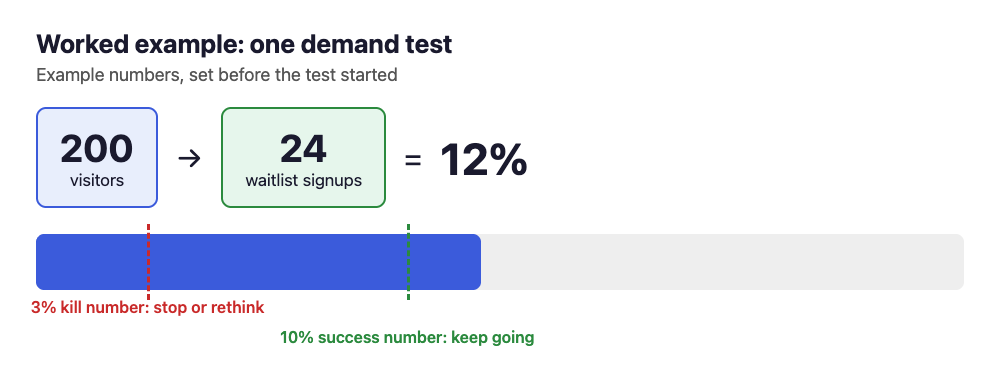
A worked example: "Freelance bookkeepers who spend hours each month chasing clients for missing receipts. I promise a tool that writes and sends the reminder messages for them. If at least 200 relevant visitors land on the page and 10 percent or more join the waitlist, I keep going. If fewer than 3 percent join, I stop or rethink the promise."
These numbers are your own judgment, not a standard. What matters is that you set them first.
How to test demand with a landing page and a waitlist: the page
Keep it to one screen of scrolling or a little more. Every extra element is something that can distract from the single action you want.
- A headline that names the outcome. "Stop chasing clients for receipts" beats "AI-powered finance assistant."
- One sentence of explanation. Say what it does and for whom.
- Three short benefits. Tie each to a result the visitor cares about.
- One form. Email only, or email plus one question.
- One button. "Join the waitlist" is fine. Do not offer a second action.
You can draft the copy with an AI assistant. A prompt like this works:
I am testing demand for a tool that writes and sends receipt reminder messages for freelance bookkeepers. Write 5 headline options, each under 10 words, that name the outcome and not the technology. Then write a one-sentence explanation and three benefits in plain language.
Pick the headline you would stop scrolling for, not the cleverest one. Be honest on the page: no screenshots of a product that does not exist, and no features you have not built. Say it is coming soon.
How to set up a waitlist that gives you real signal
A bare email field tells you someone clicked. Add one optional question and you learn much more. Good choices:
- "What is the hardest part of this today?" (free text)
- "How do you handle this now?" (free text)
- "How many clients do you work with?" (a small number field)
Free-text answers show you the visitor's own language, which you can reuse in your copy. They also tell you who is serious. Someone who writes two sentences about their pain is a better lead than someone who only typed an email.
Add a confirmation message that sets expectations: what happens next and roughly when. Then send a short, real welcome email. Ask one question in it, such as "What would make this useful to you?" Replies are the strongest signal a waitlist can give you.
If you collect emails, tell people what you will do with them and only use them for what you said. Check the rules that apply where you and your visitors live. This post is not legal advice.
Where to get your first 200 visitors
A page with no traffic tells you nothing. A zero-signup result from 12 visitors says nothing about demand. Aim for a few hundred visitors from people who actually have the problem.
- Go where the problem is discussed. Forums, groups and communities for your target person. Read the rules first and share only where it is welcome. Lead with the problem, not the link.
- Message people directly. Ten personal messages to the right people can beat a hundred random clicks.
- Ask your network for introductions to people who fit the description.
- Run a small paid test if you want speed. Keep the budget small and the targeting narrow.
Track where each visitor came from. Add a different tag to the link for each channel, and note which channel brought the signups. A channel that brings many visitors and no signups is telling you something about fit. You need numbers you can compare week to week, the same habit as in our post on what weekly growth rate an early startup should aim for, so record them from day one.
How to read the results: conversion rates and what they mean
Conversion rate is signups divided by visitors. If 200 people visit and 24 join, that is 12 percent.
Read it against the number you set at the start, and read it in context:
- Above your success number: a good sign, but check the quality of the signups before you celebrate.
- Between the two numbers: the idea may be fine and the page weak. Change the headline and run it again.
- Below your kill number: either the problem is not painful, the promise is unclear, or you reached the wrong people. Look at the free-text answers and the traffic sources to work out which.
Sample size matters. With 20 visitors, one extra signup moves the rate by 5 points. With 200, it moves it by half a point. Do not read much into small numbers, and do not borrow someone else's benchmark: it depends on traffic, offer and audience.
Turn waitlist signups into conversations and pre-sales
The waitlist is the start, not the result. Within a few days, email or message each person who signed up and ask for a 15-minute call. Ask about their current process, what they have tried, and what it costs them in time or money. The course lesson Talking to Customers Without Fooling Yourself covers how to ask questions that do not lead the witness. Do not pitch. Listen.
Then test willingness to pay. People say yes to free things easily. Ask whether they would pay, and how much, and watch how they react. A stronger test is to offer a real pre-order or a deposit once you have a clear offer. This also forces you to think about the numbers: if you charge for something that calls an AI model, you need to know what each use costs you. See how to price an AI product without losing money per user before you name a price.
If many people say they love it but nobody will pay or take a call, treat that as a real answer.
Common mistakes that give false positives
- Counting friends and family. They sign up to be kind. Exclude them from your numbers.
- Setting the bar after the fact. Decide the success number first.
- Selling a vague promise. If a visitor cannot say what you do in one sentence, a signup means little.
- Ignoring who signed up. Ten right people beat fifty wrong ones.
- Building a thin product on top of a model and calling the signups proof. Demand for an outcome is not demand for your particular version. Check yourself with is my AI startup just a thin wrapper around ChatGPT.
Frequently asked questions
What is a good waitlist conversion rate?
There is no universal number, because it depends on your traffic and your offer. Set your own success and kill numbers before the test, and judge the result against them. Targeted visitors will convert better than a broad audience.
How many visitors do I need to validate an idea?
Aim for at least a couple of hundred visitors who match your target person. Fewer than that, and a few signups either way can swing the rate too much to trust. Validation also needs conversations and a payment signal, not just a rate.
Should I charge or ask for a deposit on the waitlist?
Start free to learn quickly, then test payment with the people who signed up. A deposit or pre-order is a much stronger signal than an email. Be clear about what you are selling and do not take money for something you cannot deliver.
Get started
The lesson Project 1: A Landing Page and a Waitlist walks you through this with a problem first, something to play with, and questions that check you understood. Lessons take 8 to 12 minutes, and every lesson is free with an account.
Every lesson is free. Start learning with Age of AI Entrepreneur: sign in on the home page and take your first short lesson today.