How to Price an AI Product Without Losing Money Per User
Learn how to price an AI product without losing money per user: measure inference costs, set usage limits, pick a pricing model, and protect your margins.
If you want to know how to price an AI product without losing money per user, start with one fact: every request your product handles costs you real money. Ordinary software costs almost nothing to serve once it is built. An AI product pays a model provider each time a user clicks. Your heaviest users can cost more than they pay you.
This post walks through one worked example. You will find your cost per user, pick a margin, choose a pricing model, and add limits that protect the margin. The numbers are made up for illustration. Swap in your own.
Why AI products lose money per user
A normal subscription app has a small, steady cost per user. An AI app has a cost that rises with use. Two people on the same monthly plan can cost you very different amounts, because one sends 100 requests a month and the other sends 6,000.
Three things make this worse:
- Usage is uneven. A small group of heavy users often drives most of your bill.
- Requests are not all the same size. A long document costs more than a short question.
- Flat prices hide the problem. Revenue looks fine until the model provider's invoice arrives.
The fix is not a clever trick. It is arithmetic done before you publish a price. The lessons Revenue, Costs and Unit Economics and Pricing AI Products in Age of AI Entrepreneur cover the same ground.
Calculate your true cost per user
Model APIs charge by the token, which is a small chunk of text. You pay for the tokens you send in and the tokens the model writes back. Your first job is to turn that into a cost per request, then a cost per user. The lesson Model APIs, Tokens and What a Request Costs teaches this step.
Here is an example product: a tool that drafts customer emails. Assume these numbers, which are invented for the example:
- Each request sends 1,500 tokens in and gets 500 tokens back.
- Input costs $1 per million tokens. Output costs $4 per million tokens.
Input: 1,500 tokens at $1 per million is $0.0015. Output: 500 tokens at $4 per million is $0.002. One request costs $0.0035.
Now add the costs people forget. Some requests fail and get retried. Some users click "regenerate". Add a 20 percent buffer for that. Your real cost per request is about $0.0042. Also count hosting and payment processing in your total, even though they are small next to the model bill at first.
Next, split your users into groups. In this example:
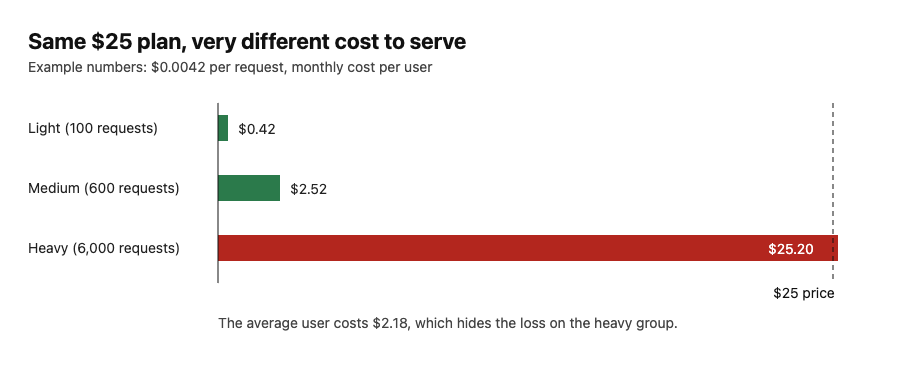
- 70 percent are light users at 100 requests a month. Cost: about $0.42.
- 25 percent are medium users at 600 requests. Cost: about $2.52.
- 5 percent are heavy users at 6,000 requests. Cost: about $25.20.
The average user sends 520 requests and costs about $2.18. That looks very safe on a $25 monthly plan. But the heavy group costs $25.20 each, which is $0.20 more than they pay, before hosting and payment fees. The average hides the loss.
Set a target gross margin before you set a price
Gross margin is the share of each sale left after the direct cost of serving the customer. Pick the margin you want first, then work backward to a price. Do not look at a competitor's page and copy the number.
The formula is simple:
price = cost per user divided by (1 minus target margin)
Say you want a 70 percent margin. For the average user, $2.18 divided by 0.30 gives about $7.27. For a heavy user, $25.20 divided by 0.30 gives $84. A single flat price cannot serve both. That is the signal to change the model, not just the number.
The lesson The Economics of AI Companies covers why margins matter for an AI business. If you are watching growth too, see what weekly growth rate an early startup should aim for. Growth that loses money on each user only makes the loss bigger.
How to price an AI product without losing money per user: choose a pricing model
You have four common options. Each one handles the heavy-user problem differently.
Flat subscription
One price, no limits on paper. It is easy to explain and easy to sell. It is also the model that exposes you to heavy users. Use it only if your cost per request is tiny or you cap use in some other way.
Usage-based
Customers pay per request, per document or per minute. Your revenue rises with your cost, so you rarely lose money on a user. The downside is that bills are unpredictable, which some buyers dislike.
Credits
Customers buy or receive a bundle of credits, and each action spends some. Big actions cost more credits than small ones. Credits let you hide token math behind a simple unit while still charging more for expensive work.
Hybrid
A flat monthly fee that includes a fixed amount of use, plus extra credits or overage once the customer passes it. For most small AI products this is the safest start. The light and medium users get a simple plan. The heavy users pay for what they use.
In our example, the hybrid plan is $25 a month with 1,500 requests included. Extra requests cost $0.01 each, or you sell a 1,000 request pack. Worst case, a user at the cap costs 1,500 times $0.0042, which is $6.30. That leaves a margin of about 75 percent on the plan, above the 70 percent target. Heavy users who go past the cap pay $0.01 for a request that costs you $0.0042, so each extra request still earns a profit.
Add usage limits and guardrails that protect margins
A price only works if the product enforces it. Build these in from the first release:
- Hard caps per plan. When a user hits the included amount, they buy more or wait for the next period.
- Input limits. Cap the size of a file or message. One huge upload costs many times what a short question does.
- Output limits. Set a maximum length for answers. In the example above, each output token costs four times an input token.
- Rate limits. Stop scripts from draining your budget in an afternoon.
- A spend alert. Get a message when daily cost passes a threshold, so you find out in hours, not at the end of the month.
- A free tier you can afford. If you offer a free plan, set a small fixed allowance and treat it as a marketing cost.
Tell users about the limits plainly, and show a usage meter in the product.
Reduce inference costs without hurting quality
Lowering cost is the other half of the margin. It helps every user at once.
- Use the smallest model that does the job. Not every task needs the biggest model. Route easy work to a small model and save the large one for hard cases. The lesson Choosing Models: Big, Small, Open, Closed explains the tradeoffs.
- Send less text. Trim long instructions and drop context the model does not need. Retrieval, taught in Giving Models Your Data: Retrieval, lets you send only the relevant passages instead of whole documents.
- Limit output length. Ask for the format you need and no more.
Check quality after every change. A cheaper model that gives worse answers can cost you customers. Run the same set of sample inputs before and after, and compare the results by hand.
Test, monitor, and adjust your pricing over time
Your first price is a guess. Treat it that way. The lesson Launching and the First Ten Customers suggests winning early customers by hand, and that is also the best time to learn what they will pay. Talk to them. Watch how they use the product.
Then track a few numbers every week:
- Average cost per active user.
- Cost for your top 5 percent of users.
- Gross margin per plan.
- How many users hit a cap, and what they do next.
Model prices change, and so does your usage. Recalculate whenever you switch models or add a feature that uses more tokens. If you cannot raise prices, you may need a better moat. A product that anyone can copy by calling the same model will face price pressure. Read is my AI startup just a thin wrapper around ChatGPT to check how exposed you are.
Frequently asked questions
What is the biggest pricing mistake in AI products?
Charging a flat price based on the average user. A small group of heavy users can cost more than they pay, and the average hides that.
Should I offer unlimited usage?
Only if your cost per request is very small or you have some other control, such as rate limits. Otherwise set an included amount and charge for extra use.
What gross margin should I aim for?
There is no single right number. Pick a target that covers your other costs, then work out the price from your cost per user. The 70 percent used here is only an example.
Is a credit system better than a flat plan?
Credits fit best when actions vary a lot in cost. For simpler products, a hybrid plan with an included amount and paid extras is usually easier for customers to understand.
How often should I review my AI pricing?
Review it whenever you change models or ship a feature that uses more tokens, and check your margin numbers every week while you are small.
Get started
The Launch, Price and Get Paid course walks through the minimum viable product, pricing AI products and winning your first ten customers. The lessons take 8 to 12 minutes each and include questions that check what you learned. They teach the ideas. They do not promise any result for your business.
Every lesson is free. Start learning with Age of AI Entrepreneur: sign in on the home page and take your first short lesson today.