Is My AI Startup Just a Thin Wrapper Around ChatGPT?
Worried your AI startup is just a thin ChatGPT wrapper? Use this honest test to spot the warning signs and build real defensibility before you scale.
Is my AI startup just a thin wrapper around ChatGPT? If you have asked yourself that, you are already ahead of many founders. The question is useful because it forces you to look at what a customer gets from you that they could not get by opening a chat window and typing a good prompt. This post gives you a plain definition, a seven question test, and a 30 day plan to work on the answer.
Is my AI startup just a thin wrapper around ChatGPT? What the term means
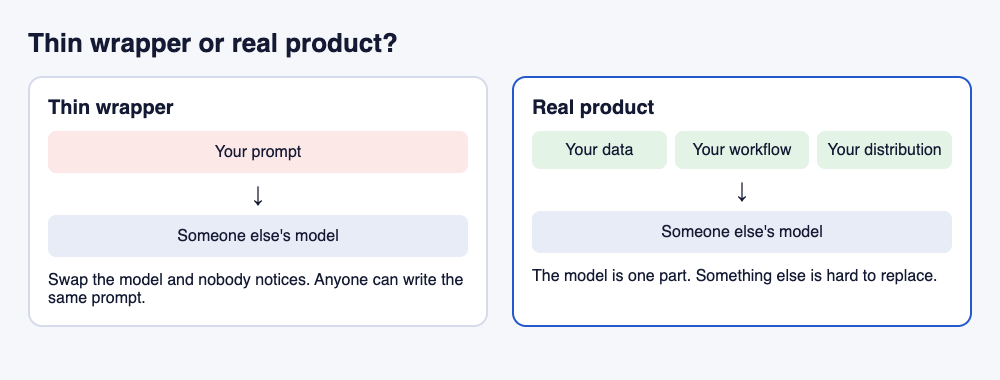
A thin wrapper is a product whose main value is a model call with a nice box around it. The user types something, you pass it to a model API with a prompt, and you show the result. Remove the model and nothing is left. Swap in a rival model and the customer cannot tell the difference.
That is not automatically bad. It is a description of where you start. The problem is staying there, because a product that is only a prompt is easy for someone else to copy.
The opposite is a product where the model is one part among several. Something else makes it hard to replace: your data, the way you fit into a customer's daily work, the trust you have built, or the channel through which customers find you. The course Finding AI Opportunities in Age of AI Entrepreneur has a lesson on this exact split, called "Thin Wrapper or Real Product?"
The 7 question test: is your AI startup just a ChatGPT wrapper?
Answer each one honestly. Write the answers down. Vague answers count as a "no".
- Could a customer get 80 percent of your value from a free chat with a good prompt? If yes, you are selling convenience at best.
- Does your product use anything the model does not already have? This could be your own data, a customer's private documents, or results from past use.
- Does it live inside a workflow? A tool that sits in the middle of how someone already works is harder to drop than a separate page they visit.
- Could you switch to a different model next week without customers noticing? If so, the model is not your edge. That is fine, but something else must be.
- Do you know how good your output is? If you judge quality only by eye, you cannot improve it in a way a competitor cannot match.
- Do customers find you through a channel you control or understand? Or does your whole business depend on one platform's mood?
- Would ten real customers be upset if you disappeared? If you have not asked, you do not know.
Score it simply. Five or more clear "yes" answers means you are building something with depth. Two or fewer means you are likely a thin wrapper today, and the rest of this post is for you.
Warning signs your product is easy to copy
- Your whole product is one prompt. If you could paste it into a post and a reader could rebuild your tool, so can a competitor.
- Your pitch is "ChatGPT for X". That tells customers the model is the product, and they already know where to find the model.
- Nothing improves with use. Customer number 500 gets the same thing as customer number 1.
- You cannot say what a request costs you. Model APIs charge by usage, measured in tokens. If you have not worked out cost per request, your pricing may be losing money on every user.
- The model maker could add your feature in a release. This is the risk of building on someone else's model, and it is worth facing directly.
The Intermediate course The AI Product Stack covers model APIs, tokens and what a request costs, which gives you the numbers behind that fourth warning sign.
Why a thin start is not the end
Being thin at the start is not a death sentence. Many useful products begin as a simple layer over something powerful. Think of the pattern in the course Platform Shifts and the Founders Who Rode Them: PCs, the internet, cloud and mobile each made something expensive cheap, and each minted a new generation of companies. Its lesson "The Collapse in the Cost of Starting" is a good place to see why that matters for a small team. AI looks like the same kind of shift, and the course has a lesson called "Why AI Is a Platform Shift" on that question. Cheap access to a strong model is what lets a small team ship at all.
A thin product can win when it:
- Solves a narrow problem very well. A tool for one job in one trade, built after talking to people in that trade, often beats a general chat window for that person.
- Removes steps, not just words. If your tool takes a messy input and produces something ready to send, file or pay, the value is in the finished result.
None of this promises that a product will earn money. That depends on the problem, the customers and your costs. The point is that "thin" describes a stage, and what matters is what you add next.
How to build a moat beyond the model
When anyone can call the same model, the model is not your moat. The Intermediate course Distribution and Moats has a lesson called "What Moats Survive When AI Is Cheap". Here are three practical places to look, in your own words.
Data
Ask what you can collect that others cannot. This might be the corrections your users make, the documents they upload, or the outcomes that follow your suggestions. Retrieval, which gives a model your own data at the moment it answers, is one way to use it. The lesson "Giving Models Your Data: Retrieval" covers the idea.
Workflow
Fit into the way work already happens. If your tool takes input from where the user already is and puts output where they need it, switching away costs them effort.
Distribution
A product with a reliable way to reach customers is stronger than a slightly better product nobody finds. Pick one channel, learn it, and measure it. The lesson "Distribution: Getting in Front of Customers" is about exactly this.
How to validate demand before you invest in more features
Do not add features to escape a demand problem. Test demand first, cheaply.
Start with a landing page and a waitlist. This is the first starter project in Your First Builds: Simple Projects, and it needs no code. State the problem, the result you give, and one button to join. Then count who clicks.
Next, talk to people. The lesson "Talking to Customers Without Fooling Yourself" is about not leading the witness. Ask about the last time they hit the problem, what they did, and what it cost them. Do not ask "would you use this?" because people say yes to be polite.
A hypothetical example: you built a tool that turns a contractor's rough call notes into a written quote. Instead of adding templates and themes, ask five contractors to show you how they write quotes today. Watch for where they lose time, what they paste from where, and what they would never trust a machine to write. Those answers tell you what to build.
A 30 day plan to turn a thin wrapper into a real business
This is a plan for learning, not a promise of results. Adjust it to your situation.
Days 1 to 7: Find out where you stand
- Run the seven question test and write your answers.
- Work out what one request costs you, then what a typical customer costs per month.
Days 8 to 14: Talk to real people
- Book conversations with five people who have the problem.
- Ask about past behavior, not future intentions.
Days 15 to 21: Add one thing the model does not have
- Pick one of data, workflow or distribution.
- Build the smallest version. This follows the idea of the MVP and the build, measure, learn loop.
- Make a small set of example inputs with the output you would call good, so you can check quality by more than eye. That is the start of an eval set.
Days 22 to 30: Win ten customers by hand
- Reach out one by one, not with a broadcast.
- Set a price that covers your cost per user with room to spare. The lesson "Pricing AI Products" covers this.
- At the end, re-run the seven questions. Note which answers changed.
Frequently asked questions
Is being a ChatGPT wrapper always a bad thing?
No. It is a starting point. It becomes a problem if the model call is your only value and nothing else makes you hard to replace.
What is the fastest way to tell if my product is a thin wrapper?
Ask whether a customer could get most of your value from a free chat and a good prompt. If yes, work on data, workflow or distribution next.
Can the model provider just copy my product?
It can, if your product is only a small feature on top of its model. That is the risk of building on someone else's platform, and it is why you want something that is yours.
Do I need to write code to test demand?
No. A landing page with a waitlist and a handful of customer conversations will tell you a lot before you build anything.
Get started
Age of AI Entrepreneur has short lessons on exactly these questions, from finding a real problem to pricing, moats and launching. Each lesson takes 8 to 12 minutes, and you can learn more on the About page or browse the blog. It teaches; it does not build or run your business for you.
Every lesson is free. Start learning with Age of AI Entrepreneur: sign in on the home page with a 6-digit code sent to your email and take your first short lesson today.