What Are LLM Evals and Why Your AI Product Needs Them
LLM evals are tests that measure whether your AI product works. Learn what they are, the main types, and how to build your first eval set this week.
If you are asking what are LLM evals and why your AI product needs them, here is the short answer. An eval is a repeatable test that tells you whether your AI product gives good answers. You need evals because without them you are guessing every time you change a prompt, a model or a setting.
What are LLM evals and why your AI product needs them
"Eval" is short for evaluation. An LLM eval is a set of example inputs, a rule for judging the outputs, and a score you can compare over time.
Think of it as a unit test for something that does not give the same answer twice. A normal function returns the same result for the same input. A language model can phrase things differently each run, and it can be wrong in ways that sound confident. So you cannot just check for one exact string. You need a way to ask: is this answer good enough, and did it get better or worse since last week?
An eval gives you that. You run your product over a fixed list of examples, score each result, and get a number. Change something, run it again, compare the numbers.
Why vibe checks stop working, and what you risk without evals
When you build your first version, you try a few prompts and read the replies. If they look fine, you ship. That is a vibe check, and it is a fair way to start.
It breaks down for two reasons.
- You only see a handful of cases. Real users send inputs you never thought of.
- You remember the last thing you fixed. You fix one bad answer and cannot tell whether you broke three others.
Age of AI Entrepreneur has a lesson called What AI Gets Wrong, in the course How Modern AI Actually Works. It covers the limits every builder must design around. A model can be wrong while sounding sure, so reading an answer and feeling good about it is not a measurement. Evals are how you measure.
Without evals, these problems tend to show up, and usually in front of customers:
- Silent regressions. You improve one case and quietly break another.
- Fear of change. You stop switching to a newer or cheaper model because you cannot tell whether quality holds.
- Arguments with no answer. Two people on your team disagree about which prompt is better, and the only tiebreaker is opinion.
- Surprise failures in production. A rare input type breaks the product and you hear about it from a customer.
The Advanced course Evals: Shipping AI That Works in Age of AI Entrepreneur is built around this idea: measure quality instead of judging by eye. Its three lessons are Why Your AI Product Needs Evals, Building an Eval Set and Judging Outputs, and Running AI in Production.
The main types of LLM evals (code checks, human review, LLM as judge)
There are three common ways to score an output. Most products use a mix.
Code checks
These are rules a program can verify. Is the output valid JSON? Does it contain the required field? Is it under 200 words? Did it avoid a banned phrase? Does the extracted date match the known date?
Code checks are cheap, fast and perfectly consistent. Use them wherever the answer can be checked by a rule.
Human review
You, or someone who knows the subject, read outputs and mark them good or bad. This is slow, but it is the most trustworthy for things like tone, helpfulness and whether advice is sensible. It is also how you learn what "good" means for your product in the first place.
LLM as judge
You ask a second model to grade the first model's output against a short rubric. For example: "Does this reply answer the customer's question using only the provided policy text? Answer yes or no, then give one sentence of reasoning."
This scales much further than human review. But the judge can be wrong too, so you check it against your own human labels before you trust it. If the judge disagrees with you often, fix the rubric first.
How to build your first eval set in a day
You do not need a platform. A spreadsheet and a script are enough. Here is a one-day plan, using a support-reply tool as the example.
- Collect 30 to 50 real inputs. Pull them from actual use if you have it. If not, write them yourself or ask a few target users for real examples. Include easy cases, hard cases and a few that should be refused.
- Write what a good answer looks like. For each input, note the key facts the answer must contain, or the mistakes it must avoid. A one-line note per row is enough.
- Add code checks first. Length, format, required fields, banned content. These take minutes and catch obvious failures.
- Add a rubric for the rest. Write two or three yes/no questions, such as "Does the reply cite the refund policy correctly?" and "Is the tone polite?"
- Label by hand. Score every output yourself. This shows you where your product actually fails.
- Optionally add an LLM judge. Run it on the same rows and compare to your labels. Keep it only if it agrees with you most of the time.
- Save the baseline score. This is the number you now try to beat.
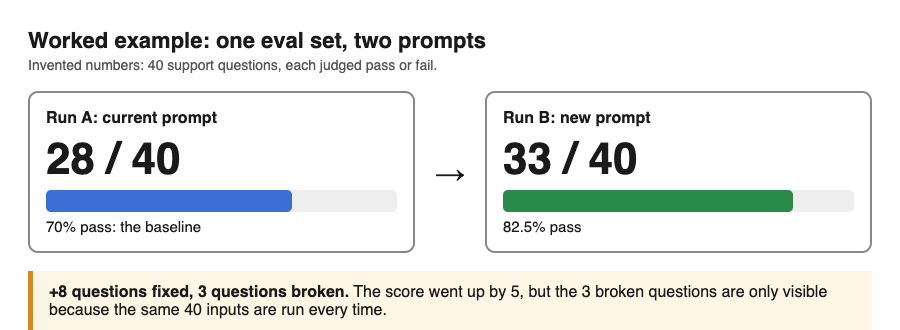
Here is what the baseline buys you, with invented numbers. Your set has 40 questions and the current prompt passes 28, which is 70%. You rewrite the prompt and run the same 40 again. Now 33 pass, which is 82.5%. That looks like a win. But the new run fixed 8 questions and broke 3 that used to pass. You only see those 3 because you ran the same inputs both times.
Then keep the set alive. Every time a real failure shows up, add that input as a new row. Over weeks, the set becomes a record of everything that has gone wrong.
What to measure: accuracy, cost, latency, and safety
Quality is not one number. Track a few, and look at them together.
- Accuracy or quality: the share of outputs that pass your checks and rubric.
- Cost: what each request costs. Model APIs charge by tokens, so longer prompts and longer answers cost more. The AI Product Stack course covers model APIs, tokens and what a request costs.
- Latency: how long the user waits. A better answer that takes three times as long may be a worse product.
- Safety: does it refuse what it should, avoid leaking data, and stay inside the task you gave it?
A useful habit is to report all four in one line per run: "Quality 82%, cost per request down 40%, slower by one second, safety cases all pass." That makes trade-offs visible.
How evals protect your margins and your pricing
This is the part many founders miss. Evals are not only about quality. They are how you safely make your product cheaper.
Say a smaller or cheaper model might handle 70% of your requests. Without evals, you cannot know which 70%, or whether users will notice. With evals, you run both models over the same set and see exactly where the cheaper one holds up. You can route easy requests to the cheap model and keep the strong model for hard ones.
That directly affects what you can charge. If each user costs you more in model calls than they pay, you lose money on every sign-up. For the pricing side, see how to price an AI product without losing money per user. Evals are what let you cut cost per request without guessing about quality.
They also bear on whether your product has real substance. The related question is covered at is my AI startup just a thin wrapper around ChatGPT. An eval set built from your customers' real tasks is something you own, because it records what good looks like for your product.
Common eval mistakes early founders make
- Testing only easy cases. Include messy, short, long, off-topic and adversarial inputs.
- Trusting an LLM judge without checking it. Compare it to your own labels first.
- Using a score you do not understand. A single "quality 8 out of 10" hides what failed. Use pass or fail on specific questions.
- Never updating the set. If production failures do not become new rows, the set goes stale.
- Building evals before talking to users. Your idea of "good" should come from what customers actually need. For one way to learn that early, see how to test demand with a landing page and a waitlist.
Frequently asked questions
What is an LLM eval?
It is a repeatable test for an AI product: a fixed set of example inputs, a way to judge each output, and a score you can compare across versions.
How many examples do I need to start?
Thirty to fifty real, varied examples is enough for a first set. Add a new row every time you find a real failure.
Can I use an LLM to grade another LLM?
Yes, this is called LLM as judge. Check it against your own hand labels first, and only rely on it if it agrees with you most of the time.
Do I need evals if I am only prototyping?
Vibe checks are fine for the first prototype. Start a small eval set as soon as real users arrive or you want to change the prompt or model with confidence.
Get started
The Advanced course Evals: Shipping AI That Works walks through why evals matter, how to build an eval set, and how to run AI in production. It sits alongside 11 other short courses, 36 lessons in total, and every lesson is free with an account.
Every lesson is free. Start learning with Age of AI Entrepreneur: sign in on the home page and take your first short lesson today.